Briggen Tre Kronor af Stockholm
This is the name of our magnificent vessel, built between 1997 and 2008 by experienced shipwrights together with craft-interested youth and students. The hull of Tre Kronor is partly built according to the drawings of HMS Gladan (which was the Swedish Navy's training ship from 1857–1924), with adaptations to today's safety requirements, work environment laws, and other changed conditions. Many private individuals, enthusiasts, organizations, and companies have been instrumental in realizing the dream of this almost unique vessel.
To ensure the best possible experience for everyone, we normally do not have more than 45 passengers on our voyages. This is the maximum number that can be seated for meals in the saloon. For more exclusive voyages, we recommend 38 people to allow for more space at the tables. When docked, we can accommodate up to 100 people for mingling on deck.
We also have berths for 16 passengers in cabins, with the possibility of installing an additional 6 beds in the saloon. Although Tre Kronor is built to evoke the authentic feel of a 19th-century vessel, she is nonetheless a modern ship fully equipped for contemporary operations. On board, there is 230 V electricity, central heating, a galley with the same standard as a restaurant kitchen, toilets and showers, and two saloons where one can sit and eat or work. Read more about sailing with Briggen Tre Kronor here.
Facts about the vessel
Tre Kronor af Stockholm
Background
The project was initiated by sea captain and teacher Jan-Erik Mansnerus and Olle Strandberg, one of Sweden's most knowledgeable sailing ship masters. They soon involved jazz musician Bunta Horn and artist Björn Lindroth. The reason for choosing a brig is its exceptionally good sailing characteristics and beautiful lines.
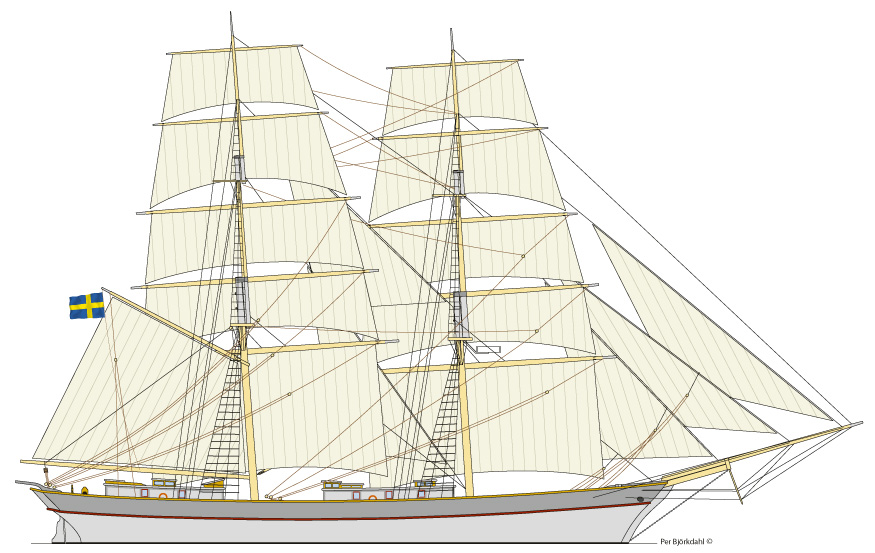
The hull design for the brig Tre Kronor af Stockholm is based on the Swedish Navy's transport ship Gladan, launched in 1857. The brig Gladan served as a cargo ship in the navy from 1857 to 1879 and then became a training ship for naval cadets from 1879 to 1924. Subsequently, she was used as crew accommodation for shipyard workers in Karlskrona harbor, where she sank in 1942 (various fates are described). Gladan also participated in an expedition to Greenland from 1870 to 1873, led by Adolf Erik Nordenskiöld. Gladan had a different, older rigging than Tre Kronor, including single and thus deep topsails, whereas Tre Kronor has rigging with divided topsails, which requires less crew.
Construction and Financing
The original drawings for the brig Gladan were found at the War Archives. Construction began in 1997 and gained momentum in 1999. The paid staff consisted of seven shipwrights (two of whom were women) and a blacksmith, all working on the construction under the leadership of shipbuilders Gustav Dillner during the project's initial phase, and subsequently Korhan Koman. Ten volunteers, equivalent to 2-3 full-time workers, assisted with the construction, performing simpler tasks under the shipwrights' instructions. The volunteers were a significant contribution. An important task was to preserve and pass on the art of shipbuilding.
The project was financed by funds from private individuals and companies, as well as events surrounding the ship's construction. Many companies donated materials worth millions of SEK to the build. The project had a support association with thousands of members who paid 200 SEK per year, providing a crucial contribution to the financing.
The launch took place in August 2005, and Crown Princess Victoria is the ship's godmother. The launch was a major public celebration with approximately 10,000 spectators around the quays. At the time of the launch, the ship was not fully equipped, and work continued until 2007 when sea trials began. On June 6, 2008, the maiden voyage around the Baltic Sea commenced. The first port of call was Mariehamn, followed by Helsinki, Tallinn, and Riga before the ship returned to Sweden.
Ship Facts
The brig Tre Kronor af Stockholm is 35 m long, and 45 m including the bowsprit. She is 8.25 m wide with a draft of 3.30 m. She weighs 325 tons, including 90 tons of lead ballast. She is built of oak, using approximately 1,000 oak trees. To make the oak planks pliable, they were placed in a 12 m long "steam box" where they were steamed for 4 hours. After that, there were 20 minutes to shape the oak plank into place. Siberian larch, which is resistant to water, was used for the deck. The ship has two pine masts and 16 sails with a total area of 735 sqm, as well as a 400 hp diesel engine. The crew consists of 8-12 people. The ship has six passenger cabins with a total of 16 berths. Additionally, there are 10 berths in the bow for the crew. The aft cabin has three berths in two cabins.
The ship is berthed at Kastellholmen, by Kolskjulet, at Örlogsvägen 11.
Kolskjulet houses a small but well-equipped workshop for maintenance and minor repairs. Kolskjulet, a culturally protected building, is otherwise used as an event venue.
Sailing Operations
The sailing season typically runs from May to October, averaging about 170 days per season. Before each season, various sailing routes around the Baltic Sea are planned and offered. These can include overnight offshore voyages or themed day trips in the archipelago. Föreningen Briggen Tre Kronor (The Brig Tre Kronor Association) organizes and operates these activities, and tickets are sold on the website. The voyages attract hundreds of passengers annually.
Many collaborative projects focusing on sustainability and youth issues have been carried out with several companies and organizations, utilizing the ship to highlight values related to environment and sustainability.